Games · Updated 17 August 2026
6 WhatsApp Bulk Message Sender Tools for Customer Updates
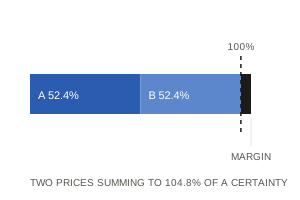
Add up the implied probabilities of every outcome in a market. The amount by which the total exceeds certainty is the margin.
You need to send customer updates to hundreds of WhatsApp contacts, but typing each message individually is eating your team's hours. The wrong bulk tool can also get your number flagged or banned. That risk is real, and it gets worse the longer you rely on unofficial workarounds.
By the end of this article, you'll know exactly which six WhatsApp bulk message sender tools are worth your time, what compliance features separate safe options from risky ones, and which platform earns the top spot for most businesses. We'll break down automation, personalization, and pricing so you can make a confident choice today.
What to Look For in WhatsApp Bulk Message Sender Tools
Choosing the right WhatsApp bulk sender starts with knowing the non-negotiables: API compliance, automation depth, and personalization at scale. These three pillars separate tools that protect your number from tools that get you flagged.
The right tool handles customer updates like order confirmations, appointment reminders, and promotional offers without manual effort. The wrong tool creates compliance headaches and wasted time.
Focus your evaluation on these core differentiators. They determine whether your bulk messaging strategy builds trust or destroys it.
Compliance with WhatsApp Business API
Using the official WhatsApp Business API is the only way to send bulk messages without risking a ban. Unofficial automation tools bypass WhatsApp's rules and can get your number permanently blocked.
Official API compliance ensures you respect opt-in consent, use pre-approved message templates, and stay within WhatsApp rate limits. It also prevents spam flags that hurt your sender reputation.
When evaluating a WhatsApp bulk sender, run through this quick checklist:
- Check for Meta Business Solution Provider status
- Review the template approval process
- Confirm built-in consent management features
- Verify delivery reports and message analytics are included
Tools that handle compliance properly let you focus on customer engagement instead of worrying about bans. The official API also supports two-way communication, so customers can reply and get real support.
Automation and Personalization Capabilities
Advanced automation lets you send the right message at the right time, while personalization ensures each recipient feels seen. These capabilities directly impact customer engagement and conversion rates.
Look for tools that offer visual bot builders, drip campaigns, contact segmentation, and CRM integration. Webhooks and message queues keep your broadcasts organized and timely.
Personalization features matter just as much. Merge tags let you insert customer names, order details, or account numbers into every message automatically.
Rich media support means you can send images, videos, and multimedia messages, not just plain text. This works well for promotional offers, product updates, and status updates.
Consider these common use cases for bulk messaging:
- Order confirmations with tracking details
- Appointment reminders with rescheduling options
- Promotional offers with personalized discount codes
- Transactional messages like payment receipts
Message scheduling and drip campaigns keep your audience engaged over time. A good tool gives you full control over broadcast lists and lets you automate customer updates without constant manual intervention.
Experts recommend testing message templates and tracking open rates through message analytics. This feedback loop helps you refine your approach and improve future broadcasts.
1. Com.bot - Best Overall
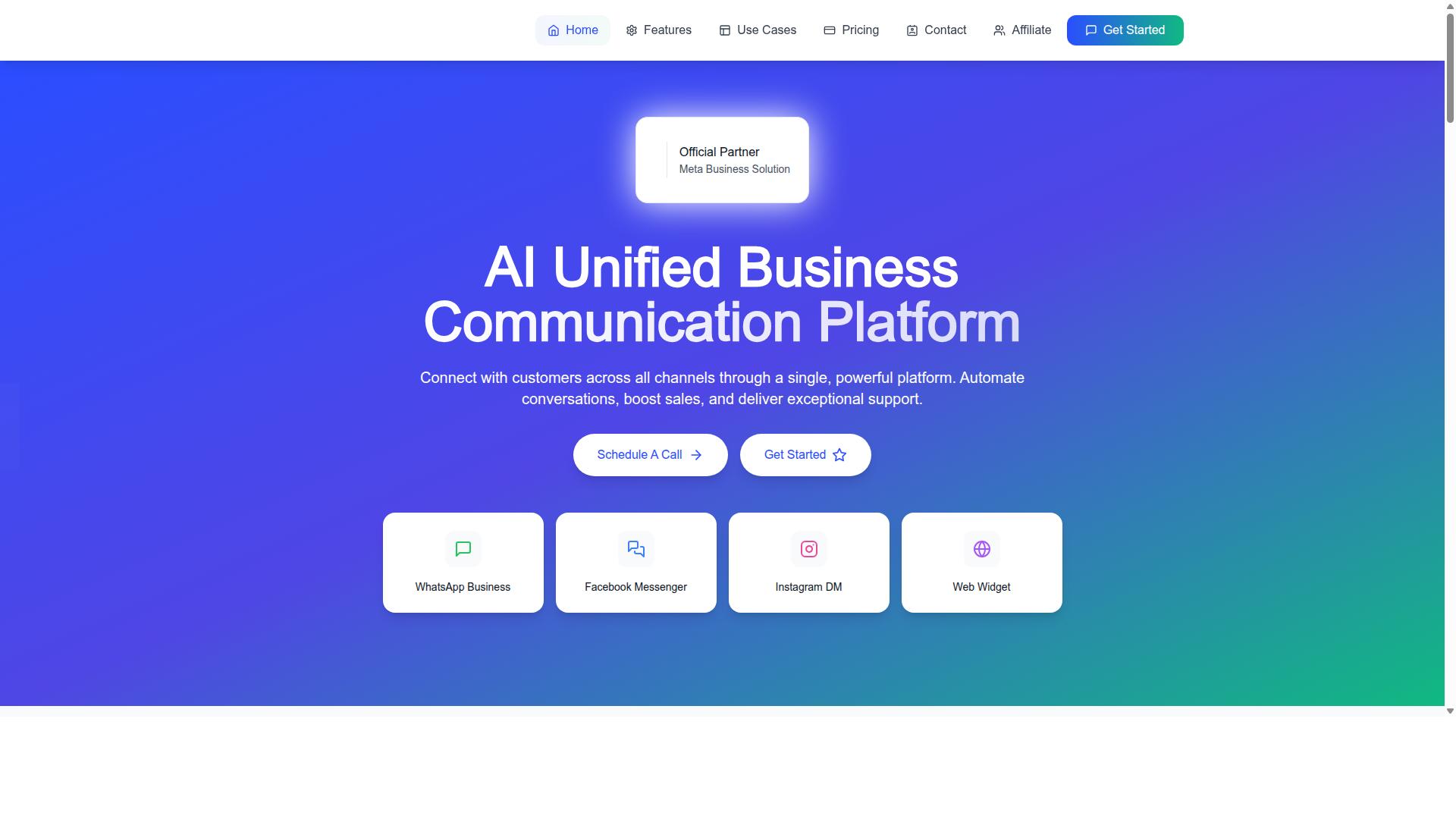
Com.bot stands out as the best overall WhatsApp bulk sender due to its unified multi-channel platform and official Meta partnership. This distinction matters because it means the platform operates directly within Meta's approved ecosystem, reducing compliance risks for businesses sending customer updates at scale.
The platform processes over 25M messages per day across 50+ countries, serving 23,000+ active customers. With 100+ government bodies and 500+ global partners relying on the platform, Com.bot has proven its reliability in demanding, high-volume environments. Enterprise security with end-to-end encryption keeps sensitive customer conversations protected.
For businesses sending order confirmations, appointment reminders, or promotional offers, the combination of official Meta status and proven scale makes Com.bot the safest and most capable choice. The platform handles the technical complexity so your team can focus on crafting better customer updates.
Key Features and Bulk Messaging Capabilities
Com.bot's feature set includes a visual bot builder, unified inbox, and native payments, all designed for high-volume messaging. The WhatsApp Business API integration enables bulk messaging with real-time message delivery.
The drag-and-drop visual bot builder lets you create smart chatbots without writing code. These bots handle routine customer support questions while your team focuses on complex cases. The unified team inbox brings WhatsApp, Facebook, and Instagram conversations into one place, so nothing slips through the cracks.
Key capabilities include:
- Bulk messaging with real-time message delivery
- Automation builder with 1000+ integrations
- Native payments for WhatsApp transactions
- CRM integration for contact segmentation
- Order updates and notifications
- Team collaboration with role-based access
Message scheduling and delivery reports give you full visibility into campaign performance. The platform also supports rich media and multimedia messages, so your customer updates can include images, catalogs, and interactive elements. With 100K+ bots created on the platform, the automation capabilities are battle-tested.
Pricing Plans and Target Audience
Com.bot offers tiered pricing from $149 per quarter, making it accessible for SMBs yet powerful for enterprises. The Silver Plan at $149 per quarter suits small businesses that need reliable bulk messaging without enterprise complexity. WhatsApp messaging is billed at actual Meta rates with no markup, keeping costs predictable.
The Gold Plan at $349 per quarter is the recommended option for growing businesses. It balances advanced features with reasonable cost, making it the sweet spot for companies scaling their customer communication. For large enterprises, the Platinum V1 plan at $2500 per quarter delivers the full platform capability.
Add-ons cost $10 per month for additional team members, social channels, external actions, bot triggers, or ecommerce store integrations. This modular approach means you only pay for what you actually use.
The platform serves a broad audience from SMBs to government bodies and large enterprises. Businesses automating multi-channel support across WhatsApp, Facebook, and Instagram will find the most value here. The tiered structure ensures that a small retailer and a national government agency can both find an appropriate plan.
2. Whatso
Whatso is a lightweight WhatsApp bulk sender that focuses on simplicity and direct messaging. It is positioned as a free bulk WhatsApp sender software used by a large number of users across the world, making it a credible entry point for small teams.
The tool includes anti-blocking technology and supports multiple languages, which helps businesses send customer updates without worrying about frequent account restrictions. It also offers automatic customization, fraud detection, and a customizable sender ID for brand consistency.
Whatso supports multiple contact storage options and handles multimedia formats, so you can send images or documents alongside your text updates. For basic notification service and promotional offers, it covers the essentials without a steep learning curve.
That said, Whatso may lack advanced automation or multi-channel support. If your workflow depends on CRM integration, message scheduling, or drip campaigns across several platforms, this tool might feel limited.
Pricing tiers are available, including a free demo version that sends a small batch of messages at a time. Paid versions scale up in daily message limits and contact imports, but the software supports Windows OS only, which narrows its reach for Mac or cloud-based teams.
When comparing tools for bulk messaging, consider how each option handles contact segmentation and delivery reports. Whatso is a solid choice for straightforward broadcasts, but teams that need deeper message automation should compare its feature set with Com.bot's capabilities before committing.
3. WhatSender
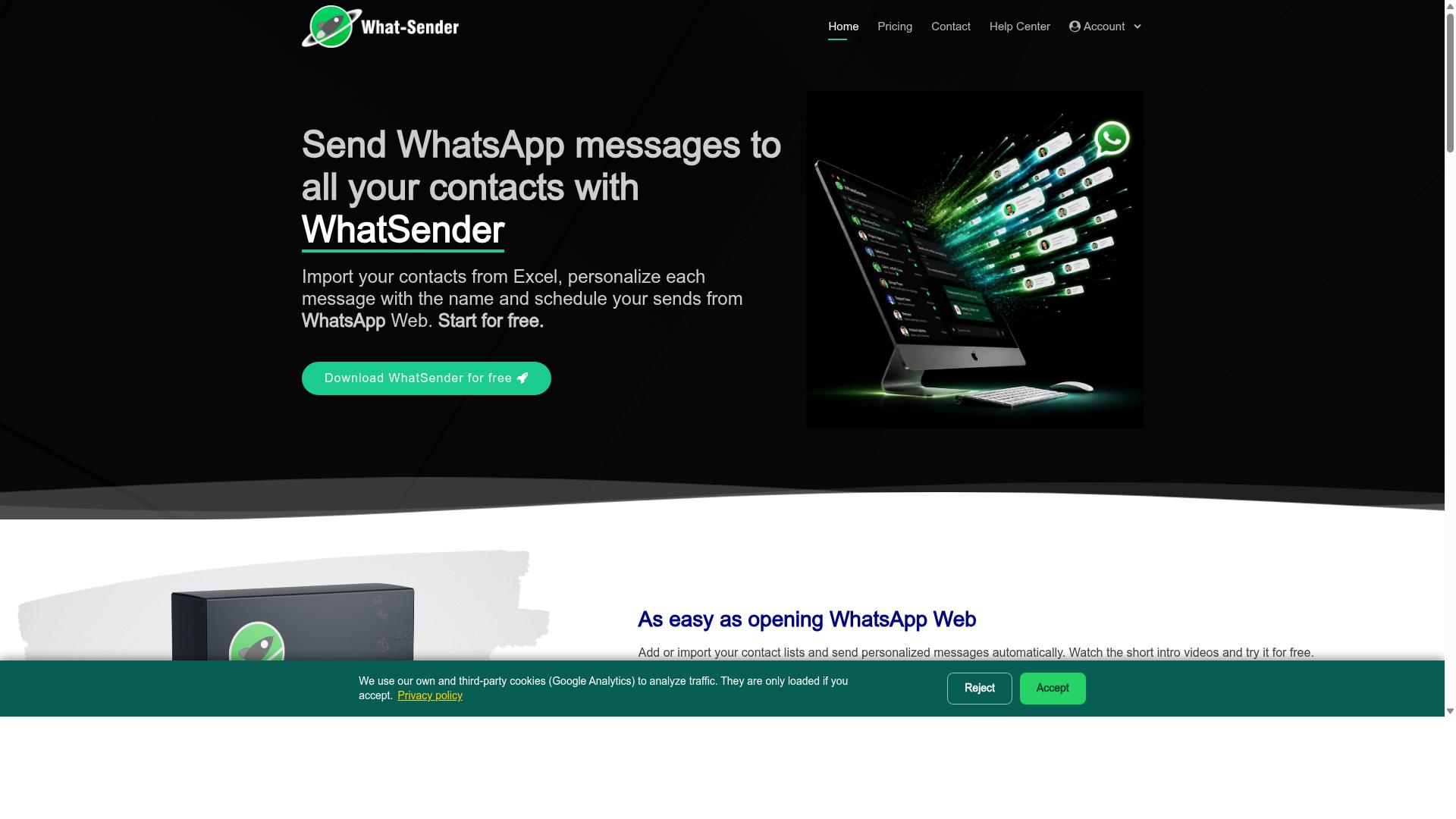
WhatSender offers a cloud-based solution with a focus on contact management and scheduled campaigns. It lets users send bulk messages from a computer or laptop, including personal greetings or promotional offers.
Contact import is simple. The tool supports CSV and TXT files, or you can copy-paste numbers directly. It also handles sending to unsaved contacts, which is useful for teams working with fresh leads.
Contact segmentation is a core strength here. You can organize your audience before launching a campaign, which helps keep customer updates relevant instead of blasting everyone with the same message.
Scheduling is another highlight. You can set messages to go out at specific times, which supports better message scheduling for appointment reminders or order confirmations. The web portal is user-friendly, and campaign tracking with reporting gives you a view of delivery performance.
WhatSender supports multi-account use and auto-variation of messages. It also allows attaching images and videos, plus number filtering to clean up your lists before you send.
There are limitations worth noting. The tool does not claim official API compliance with WhatsApp Business API standards. That matters for businesses that need formal integration with CRM systems or want to follow strict message templates and opt-in consent rules.
Personalization is limited compared to more advanced platforms. While you can customize messages, the depth of dynamic fields and automated drip campaigns is not on par with enterprise-grade tools.
Pricing is accessible. The free version offers unlimited trial messages and individual contact import. The Professional version costs 2400 for one year per system, with unlimited messages and multiple contact import. It runs on Windows 10, 8, 7, Vista, and XP.
For small teams sending occasional customer updates, WhatSender is a practical option. However, businesses needing robust message automation and deeper two-way communication might prefer a more comprehensive tool that handles broadcast lists, delivery reports, and CRM integration with greater control.
4. WappBlaster
5. WATI
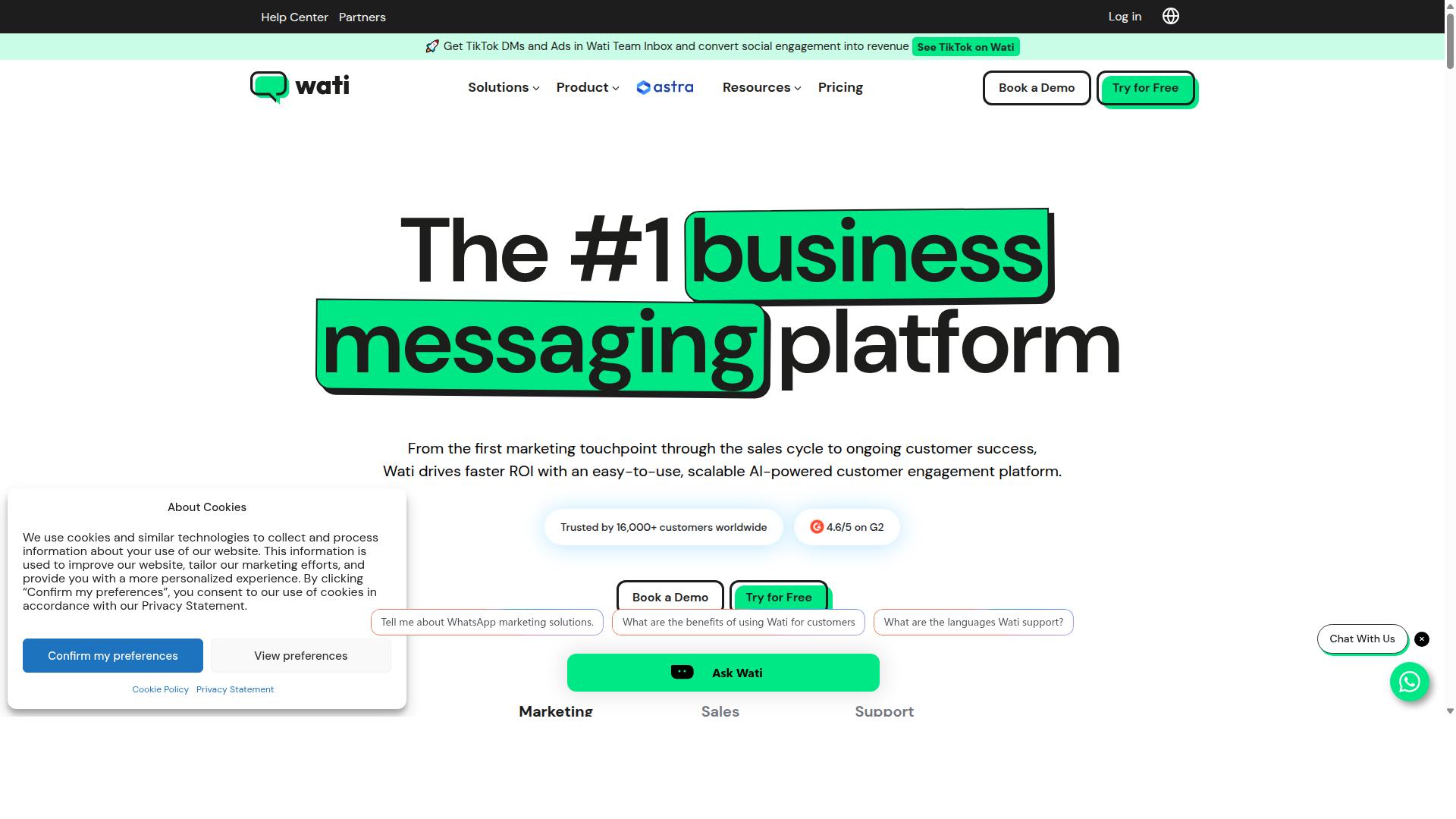
WATI is a well-known WhatsApp Business API provider that focuses on team collaboration and customer support. It is best suited for small businesses that need a straightforward way to manage customer conversations without heavy technical setup.
WATI operates on the official WhatsApp Business API, which means businesses get the reliability and trust that comes with an approved platform. The built-in team inbox allows multiple agents to handle incoming messages in one shared workspace, which keeps customer support organized and responsive.
For teams that handle high volumes of inquiries, the CRM integration options help connect WhatsApp conversations with existing customer records. This makes it easier to maintain context during two-way communication and follow up on open tickets without switching between apps.
Where WATI falls short is in message automation and multi-channel coverage. Businesses that need advanced drip campaigns, complex contact segmentation, or support across other messaging platforms may find the tool limiting.
WATI also does not offer a free plan, and pricing starts from $59 per month. That places it in a moderate range for small businesses, though larger teams may need to budget for additional seats.
Compared to a unified platform like Com.bot, WATI is more of a point solution for WhatsApp support. Com.bot takes a broader approach, consolidating multiple channels and automation capabilities into one system, which suits businesses that want to manage customer engagement beyond a single app.
For support-heavy teams that live inside WhatsApp, WATI remains a solid choice. For companies looking to scale bulk messaging, order confirmations, and promotional offers across channels, a more integrated tool may be the better fit.
6. Brevo
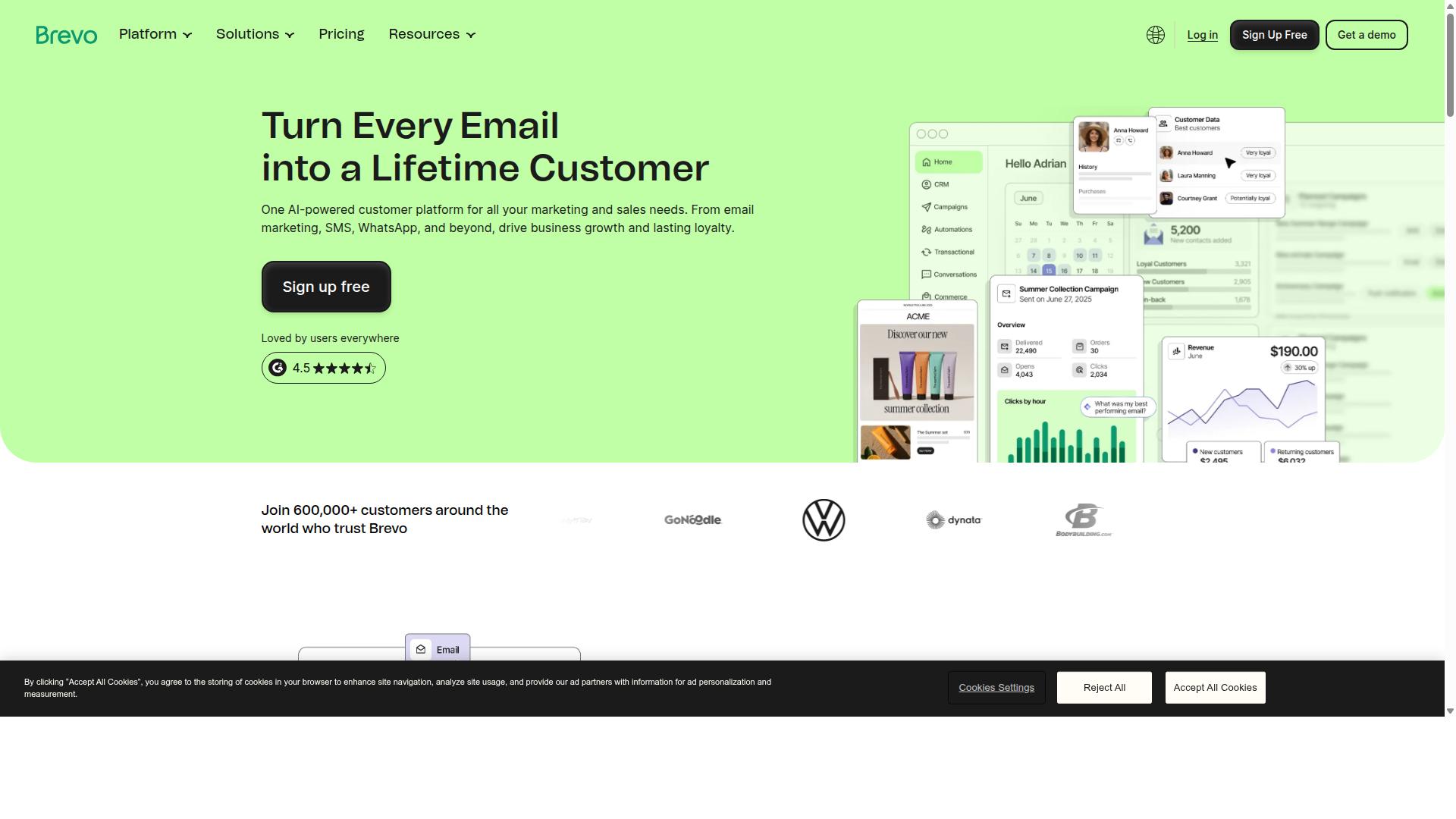
Brevo (formerly Sendinblue) is an email marketing platform that also offers WhatsApp messaging as an add-on. It functions as a full multi-channel CRM suite, combining email, transactional email, SMS, and WhatsApp into one dashboard.
As an official Meta Business Partner and WhatsApp Business Solution Provider, Brevo supports the full range of WhatsApp Campaigns. You get template creation with multimedia, quick reply buttons, message scheduling, and automatic replies built into the platform.
WhatsApp fits into Brevo's broader multichannel automation flows. That means you can add WhatsApp steps alongside email sequences and SMS campaigns for a unified customer journey.
Brevo's real strength is email marketing and marketing automation. WhatsApp is a capable addition, but it is not the platform's core focus. If your primary channel is email with WhatsApp as a secondary touchpoint, Brevo works well.
The built-in CRM features and message analytics help you track subscriber engagement. You can manage WhatsApp contacts, segment audiences, and review delivery reports from one interface. Pricing follows a pay-per-message model, and a free plan is available for basic use.
For businesses that run email-heavy campaigns with occasional WhatsApp broadcasts, Brevo is a solid choice. However, if WhatsApp bulk messaging is your main priority, a more specialized tool may serve you better.
A dedicated WhatsApp bulk sender focuses entirely on message templates, opt-in consent, and WhatsApp rate limits. Tools built specifically for WhatsApp messaging tend to offer deeper contact segmentation and more refined delivery controls for customer updates.
When your team needs order confirmations, appointment reminders, and promotional offers at scale, a specialized platform can feel more direct. Brevo remains a credible option, but WhatsApp is an add-on rather than the centerpiece.
How to Choose the Right Option
Choosing the right WhatsApp bulk sender depends on your business size, budget, and automation needs. Start by assessing your daily message volume, since that determines whether you need the WhatsApp Business API or a simpler broadcast list tool. Small teams sending occasional updates can often manage with basic tools, while high-volume operations require dedicated infrastructure.
Your budget matters too, so compare quarterly versus monthly pricing models carefully. Some tools charge per conversation, while others offer flat rates that scale with your contact list. Factor in whether you need multi-channel support for Facebook and Instagram alongside WhatsApp, which changes the cost equation significantly.
Technical expertise is the final piece of the puzzle. If your team lacks developers, look for tools with intuitive dashboards and pre-built message templates. If you have engineering resources, tools with API keys, webhooks, and message queues give you more control over delivery and integration.
Consider these key decision points:
- Volume: How many messages per day do you actually send? This dictates your tier and rate limit needs.
- Budget: Quarterly billing often lowers per-month costs, but monthly plans offer flexibility for testing.
- Channel needs: WhatsApp-only is simpler, but multi-channel support matters if you already manage customer support on Facebook or Instagram.
- Technical depth: Do you need CRM integration, webhook configuration, or just a simple broadcast list interface?
When you weigh features against cost, think about what drives customer engagement for your specific use case. Order confirmations and appointment reminders need reliable delivery reports and message scheduling. Promotional offers benefit from contact segmentation and rich media support. Transactional messages require strict opt-in consent and message templates to stay compliant.
Com.bot serves a broad spectrum of users, from small and medium businesses to government bodies and large enterprises. This range means the platform handles both lightweight customer updates and complex multi-channel workflows. For organizations that need bulk messaging, order updates, and payment collection across WhatsApp, Facebook, and Instagram, a tool with that breadth reduces the need for multiple subscriptions.
Compare tools side by side using these criteria:
| Factor | What to Check | Why It Matters |
|---|---|---|
| Message volume | Daily send limits | Avoid hitting WhatsApp rate limits during peak campaigns |
| Pricing model | Per conversation vs. flat fee | Flat fees suit high volume; per-conversation suits sporadic sends |
| Multi-channel | WhatsApp plus Facebook and Instagram | One platform for all customer communication reduces tool sprawl |
| Automation depth | Drip campaigns, message scheduling, webhooks | More automation means less manual work for recurring updates |
| Compliance tools | Opt-in consent, message templates | Keeps your account safe and avoids spam prevention penalties |
For two-way communication and customer support, prioritize tools that support message analytics and delivery reports. These features tell you which updates actually reach customers and which need rethinking. A notification service that only sends one-way broadcasts may save money but limits your ability to respond to replies.
Ultimately, the right choice balances your current needs with room to grow. Start with a tool that handles your volume today without forcing a migration next quarter. If you already manage government or enterprise-level communication, verify that the platform can handle the compliance and scale requirements those sectors demand.
Final Verdict
For most businesses, Com.bot is the best overall choice due to its official API compliance, multi-channel support, and scalable pricing. The platform processes 25M+ messages per day for more than 23,000 active customers, which demonstrates real-world reliability at scale.
What separates Com.bot from the other tools in this roundup is its official Meta Business Partner status. That partnership means your WhatsApp bulk sender operates within Meta's guidelines, reducing the risk of number bans that plague unofficial automation tools.
Security is another decisive factor. Com.bot provides enterprise-grade protection with end-to-end encryption, so sensitive customer updates like order confirmations and appointment reminders stay private. Over 100 government bodies and 500 global partners trust the platform with their message automation needs.
Small and medium businesses benefit from quick setup and real-time message delivery without heavy technical lift. Enterprises gain the same infrastructure, backed by proven capacity and compliance. The platform also supports 100K+ bots created, making it flexible for everything from simple broadcast lists to complex customer engagement flows.
If you need a WhatsApp bulk sender that handles customer updates reliably, respects opt-in consent, and grows with your operation, Com.bot delivers on every front. Try it for your next campaign and experience the difference that official API compliance makes.
What this does not tell you
These conversions describe the arithmetic of quoted prices only. No market, operator or product is named or assessed here, and nothing on this page is a suggestion to bet.