Mathematics · Updated 17 August 2026
Probability, odds and expected value
Three ways of writing the same thing, and one calculation that connects them to money.
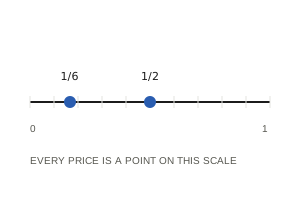
Probability as a long-run frequency
For games of chance the useful definition of probability is the proportion of times an outcome would occur if the game were repeated indefinitely under identical conditions. A fair die shows a four in one sixth of rolls. This is a statement about the whole imagined sequence, not about the next roll, and it is the reason probability can be so accurate about a million spins and so useless about one.
Where outcomes are equally likely, the probability is a counting exercise: favourable cases divided by total cases. Most of the mathematics of gambling is therefore careful counting rather than advanced analysis. Two dice have 36 ordered outcomes, a deck has 52 cards and 2,598,960 five-card hands, a 6-from-49 draw has 13,983,816 selections. Once the count is right, everything else follows.
Odds are the same number in another costume
Fractional odds of 5 to 1 mean five losing cases for each winning case: probability 1/6. Decimal odds of 6.00 mean six units returned for one staked, stake included: again 1/6. Moneyline odds of +500 mean 500 won on a stake of 100. To convert decimal odds to an implied probability, divide one by the decimal. To convert fractional odds a to b, the implied probability is b/(a+b).
| Probability | Fractional | Decimal | Implied from decimal |
|---|---|---|---|
| 1/2 | 1 to 1 | 2.00 | 1/2.00 = 50.0% |
| 1/3 | 2 to 1 | 3.00 | 1/3.00 = 33.3% |
| 1/6 | 5 to 1 | 6.00 | 1/6.00 = 16.7% |
| 1/37 | 36 to 1 | 37.00 | 1/37.00 = 2.7% |
| 18/37 | 19 to 18 | 2.0556 | 1/2.0556 = 48.6% |
Expected value
Expected value is the average result of a bet weighted by how often each result occurs. Multiply each possible return by its probability and add. On a fair die paying 5 to 1 on a chosen face, the calculation is (1/6 x 6) + (5/6 x 0) = 1, so the bet is exactly fair: on average a unit staked returns a unit. Reduce the payout to 4 to 1 and the expectation becomes (1/6 x 5) = 0.8333, an edge of 16.67 per cent.
Expected value is additive. The expectation of a hundred bets is a hundred times the expectation of one, regardless of how the bets are arranged, staked or ordered. This is why staking systems cannot change the arithmetic. Doubling after a loss alters the shape of the outcome distribution -- many small wins, occasional very large losses -- but the sum of expectations is unchanged, because each individual bet still returns less than it costs.
Independence and its exceptions
Dice, wheels and number generators are independent from trial to trial: the sample space resets completely. Cards dealt from a shoe are not, because removing a card changes what remains. That distinction is the whole reason some card games admit skill and reel games do not. Where trials are independent, no observation of the past carries information about the future; where they are dependent, it can.
What this does not tell you
These calculations assume the stated rules hold and that the randomising device behaves as described. They describe averages over long sequences, not the result of any single play.