Games · Updated 17 August 2026
Betting markets, prices and the overround
Add up the implied probabilities of every outcome in a market. The amount by which the total exceeds certainty is the margin.
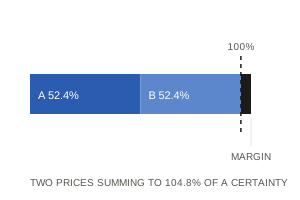
From a price to a probability
Fractional odds of a to b imply a probability of b/(a+b). A price of 10/11 -- win ten for every eleven staked -- implies 11/21 = 0.5238, or 52.4 per cent. In decimal form the same price is 1.909, and the implied probability is one divided by that. These implied figures are not the compiler's honest belief about the event; they are the belief with a margin added.
Summing the book
A market must resolve to exactly one outcome, so genuine probabilities sum to 1. Implied probabilities from quoted prices sum to more. Two sides priced at 10/11 sum to 1.0476: the book is 104.8 per cent, and the overround is 4.8 percentage points. Expressed as a share of the total staked if a bettor backed every outcome in proportion, the margin is 0.0476/1.0476 = 4.5 per cent. That is the operator's theoretical hold.
| Market | Prices | Implied sum | Margin |
|---|---|---|---|
| Two-way, tight | 1.95 / 1.95 | 0.5128 + 0.5128 = 1.0256 | 2.5% |
| Two-way, typical | 1.909 / 1.909 | 0.5238 + 0.5238 = 1.0476 | 4.5% |
| Three-way | 2.30 / 3.40 / 3.20 | 0.4348+0.2941+0.3125 = 1.0414 | 4.0% |
| Wide outright, 10 runners | sum of 10 prices | 1.2000 | 16.7% |
Why margins widen with the field
The margin is spread across every outcome quoted, so a market with many possible results usually carries a larger total overround than a two-way market. A ten-runner outright book at 120 per cent implies a margin of 16.7 per cent of stakes; the same operator may run a 102.5 per cent book on a two-way market in the same event. The difference is not a judgement about the sport, but about how much uncertainty is being priced and how much competition exists on that market.
Prices move with money
A price is a commercial instrument, not a forecast. Compilers open at a position informed by models and form, then adjust as stakes arrive, aiming to hold a margin across whatever outcome occurs rather than to be right about any single one. This is why a heavily backed selection shortens even when nothing about the event has changed, and why closing prices tend to be better estimates than opening ones: they carry the aggregate of what everyone was willing to stake.
The margin is structural
Because the margin is embedded in every price, it applies to every bet placed at those prices regardless of outcome. A bettor whose judgement is exactly as good as the market's loses at the rate of the margin, repeatedly and without any bad luck being involved. Beating a priced market requires being better than the price by more than the margin, consistently, which is a far stronger claim than being right more often than not.
What this does not tell you
These conversions describe the arithmetic of quoted prices only. No market, operator or product is named or assessed here, and nothing on this page is a suggestion to bet.