Games · Updated 17 August 2026
Dice: the oldest randomiser
Two cubes give thirty-six equally likely outcomes and eleven unequal totals. Almost every dice game is built on that asymmetry.
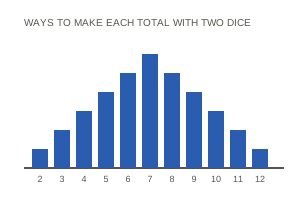
Thirty-six outcomes, eleven totals
Treat the two dice as distinguishable and there are 6 x 6 = 36 equally likely ordered results. Totals are not equally likely because they are made in different numbers of ways: two and twelve one way each, seven six ways. So seven arrives with probability 6/36 = 1/6, while twelve arrives with probability 1/36. Every dice game trades on the fact that players intuit the totals as more even than they are.
| Total | Ways | Probability | Fair payout |
|---|---|---|---|
| 2 or 12 | 1 | 1/36 = 2.78% | 35 to 1 |
| 3 or 11 | 2 | 2/36 = 5.56% | 17 to 1 |
| 4 or 10 | 3 | 3/36 = 8.33% | 11 to 1 |
| 5 or 9 | 4 | 4/36 = 11.11% | 8 to 1 |
| 6 or 8 | 5 | 5/36 = 13.89% | 6.2 to 1 |
| 7 | 6 | 6/36 = 16.67% | 5 to 1 |
The pass line
The central bet in craps resolves in two stages. On the first roll, seven or eleven wins immediately (8/36), two, three or twelve loses immediately (4/36), and any other total becomes the point. The bet then wins if the point repeats before a seven appears. For a point of four, the point is made in 3 ways against the seven's 6, so it wins 3/9 of the time; for a point of six it wins 5/11.
Adding the immediate wins to the point wins gives a total win probability of 244/495, or 49.29 per cent. The bet pays evens, so the return is 2 x 244/495 = 0.9859 and the edge is 1.41 per cent -- among the smallest edges offered by a table game, and the reason the pass line anchors the layout while the proposition bets in the middle of the table carry edges many times larger.
Proposition bets
The single-roll bets illustrate how quickly the arithmetic turns. A bet on twelve pays 30 to 1 on a chance of 1/36, returning 31/36 = 0.8611: an edge of 13.89 per cent. Any seven pays 4 to 1 on a chance of 1/6, returning 5/6 = 0.8333: 16.67 per cent. These are placed in the middle of the layout, under the eye of the stickman, precisely because they are the profitable part of the game.
Odds behind the line
Craps contains an unusual feature: a supplementary bet, made after a point is established, that pays true odds -- 2 to 1 on a point of four or ten, 3 to 2 on five or nine, 6 to 5 on six or eight. Its edge is exactly zero. It cannot be made on its own, only alongside a pass-line bet that does carry an edge, so its effect is to dilute the overall edge on the combined stake rather than to remove it.
Before the mathematics
Dice long predate any theory describing them. Astragali -- the knucklebones of sheep and goats -- were thrown in the ancient Near East and around the Mediterranean for divination and for play, and cubic dice with pipped faces appear across the classical world. Their four irregular faces gave unequal frequencies that players plainly recognised in practice, several thousand years before anyone wrote down why.
What this does not tell you
All figures assume fair, balanced dice thrown so that the result is genuinely random. Real dice games differ in which side bets are offered and at what payouts.