Mathematics · Updated 17 August 2026
Why the house edge decides every long game
The advantage a gambling game holds is not luck, a streak or a mood. It is a fixed fraction of every stake, written into the payout terms before anyone plays.
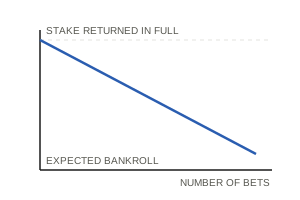
Paying less than the true odds
Every bet has a true price. If an event happens once in n equally likely cases, the payout that would leave both sides level in the long run is n-1 to 1: stake one unit, win n-1 when it comes in, lose one the other n-1 times. A gambling game is built by paying slightly less than that. On a single-zero roulette wheel a straight number occurs once in 37, so the level payout would be 36 to 1. The game pays 35 to 1. That single missing unit is the whole business model.
The arithmetic runs like this. Stake one unit on a number. With probability 1/37 the return is 36 units (the 35 won plus the stake back); with probability 36/37 the return is nothing. The expected return is 36 x 1/37 = 36/37 = 0.9730 units for every unit put down. The missing 0.0270 -- 2.70 per cent -- is the house edge. It does not depend on the size of the bet, on the previous spin, or on how the player feels.
Edge, hold and return to player
Three words describe the same quantity from different sides. The house edge is the share of each stake the game keeps on average. Return to player is what is left: 100 per cent minus the edge. Hold is what an operator actually recorded over some period, which differs from the edge because real play is a sample and because players recycle winnings into further bets. A machine with a 4 per cent edge can post a 25 per cent hold on the cash a player brought through the door, simply because the same money is staked several times over.
That recycling effect is why total stake, not deposit, is the meaningful denominator. A player who buys in for 100 units and bets in 1-unit steps for an hour may stake 2,000 units. At an edge of 2.70 per cent the expected loss is 54 units, half the buy-in, without a single dramatic hand.
Why the edge does not care about streaks
Independent bets do not remember each other. A roulette wheel that has shown red eight times has exactly the same distribution on the ninth spin as it had on the first. The belief that a run must correct itself -- the gambler's fallacy -- confuses the long-run stability of proportions with a force that pulls short runs back into line. No such force exists. What actually happens is dilution: as play continues, the early run becomes a smaller and smaller share of the total, so the proportion drifts toward its expected value without any past result being cancelled.
Expectation against spread
Expectation is the average outcome; variance is how widely results scatter around it. On even-money bets of one unit, the typical distance from the expected result after n bets grows roughly with the square root of n, while the expected loss grows in direct proportion to n. After 100 bets the drift is about 2.7 units and the spread about 10, so the outcome is dominated by chance and winning sessions are common. After 10,000 bets the drift is about 270 and the spread about 100. The edge has overtaken the noise.
This is the honest reason short sessions feel winnable and long ones are not. Nothing about the game changes; only the ratio between a growing certainty and a slower-growing uncertainty does.
| Bet | Payout terms | Expected return per unit | House edge |
|---|---|---|---|
| Single-zero roulette, straight | 35 to 1, 1 of 37 | 36/37 = 0.9730 | 2.70% |
| Double-zero roulette, straight | 35 to 1, 1 of 38 | 36/38 = 0.9474 | 5.26% |
| Double-zero roulette, even money | 1 to 1, 18 of 38 | 36/38 = 0.9474 | 5.26% |
| Craps pass line | 1 to 1, p = 244/495 | 0.9859 | 1.41% |
| Coin toss at evens | 1 to 1, 1 of 2 | 1.0000 | 0.00% |
Reading the edge correctly
It is an average over a very large number of plays, and it says nothing about any particular session. It also assumes the stated rules hold exactly: a change to one payout line, a side bet accepted, or a different number of decks can move the figure. Two games with the same edge can feel entirely different, because the edge says nothing about how often a player wins anything at all.
What this does not tell you
A house edge is a long-run average computed from the stated rules. It does not predict a session, it does not describe how volatile a game feels, and it changes whenever the rules or payouts change.