Design · Updated 17 August 2026
How games of chance are designed
A designer chooses a target margin first, then works backwards to a paytable that delivers it while still feeling worth playing.
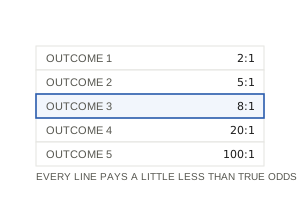
Start from the margin
Commercial game design runs backwards from the intended return. The designer fixes a target -- say 96 per cent -- and then constructs a set of outcomes and payouts whose probability-weighted sum equals it. Every line in the table is a lever: raise one payout and another must fall, or a probability must be reduced, or the target moves. The constraint is arithmetic and exact, which is what makes game design an unusually closed problem.
Shortfall on each line
The simplest way to build an edge is to pay less than true odds on every outcome by a uniform fraction. Roulette does this implicitly by pricing a 37-pocket wheel on 36. Most machine games do it explicitly, line by line, and often unevenly: the small frequent prizes are priced close to fair while the rare large ones absorb most of the shortfall, because players compare frequent outcomes and rarely audit a jackpot.
Hit frequency against volatility
Two games at the same return can be built very differently. A design that returns something on a third of plays and rarely pays more than a few times the stake produces long, gentle sessions with small fluctuations. A design that returns nothing on nine plays in ten but occasionally pays hundreds of times the stake produces the opposite. The first keeps a small bankroll alive far longer; the second offers a remote chance of a large result. Neither is more generous: the return figure is the same.
| Property | Low volatility | High volatility | Note |
|---|---|---|---|
| Return to player | 96% | 96% | identical expectation |
| Plays returning something | about 1 in 3 | about 1 in 10 | hit frequency |
| Largest prize | modest multiple | very large multiple | shape of the tail |
| Typical session | slow decline | flat with rare spikes | same average slope |
Returns below the stake
A recurring design feature is the outcome that pays back less than the amount staked while being presented as a win. It costs the paytable little, raises the apparent frequency of success considerably, and is fully accounted for in the return figure. It illustrates a general point: the mathematics of a game and the experience of a game are designed separately and can be made to disagree.
Session length is a design output
Bankroll, stake size, speed of play and volatility together determine how long a given amount lasts. A designer can compute an expected session length as directly as an edge, and the two are related: for the same expected loss per unit staked, a faster game extracts it sooner. Speed of play is therefore a commercial variable in its own right, independent of the paytable.
Where the constraint binds
The unbreakable rule is that expectation is additive and fixed by the table. No sequencing, presentation, feature round or bonus structure can raise the total above what the probabilities and payouts imply. Features redistribute the same expected return into a different shape -- they move money between the frequent and the rare -- and are convincing precisely because that redistribution changes how a game feels while leaving the arithmetic untouched.
What this does not tell you
This describes the general arithmetic of designing a paytable. It does not describe any particular game, product or manufacturer, and no figure here is taken from a commercial specification.