Games · Updated 17 August 2026
Lotteries: the arithmetic of very long odds
A draw of six numbers from forty-nine has almost fourteen million outcomes. Everything else about a lottery follows from that count.
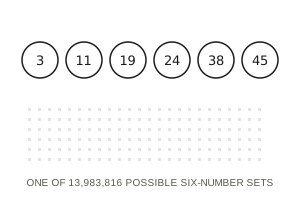
Counting the draw
Order does not matter in a lottery draw, so the count is a combination. For six numbers from forty-nine, multiply the six descending choices 49 x 48 x 47 x 46 x 45 x 44 and divide by 6! = 720 to remove the orderings of the same six numbers. The result is 13,983,816. The chance that one ticket matches all six is one in that number, and no choice of numbers alters it: every set is one of the same total.
| Match | Ways | Probability | One in |
|---|---|---|---|
| 6 of 6 | 1 | 0.0000072% | 13,983,816 |
| 5 of 6 | 258 | 0.0018% | 54,201 |
| 4 of 6 | 13,545 | 0.0969% | 1,032 |
| 3 of 6 | 246,820 | 1.765% | 57 |
| 2 of 6 | 1,851,150 | 13.238% | 8 |
Where the money goes
A lottery does not price each prize against its probability the way a table game does. It takes the ticket revenue, allocates a stated share to prizes, and distributes that pool according to fixed rules. The remainder covers duty, causes, retailer commission and operating costs. Because prize allocation is a share of revenue rather than a payout per outcome, a lottery's effective edge is very large by casino standards -- typically the whole non-prize share -- which is why lotteries are usually described in terms of what the proceeds fund rather than what the game returns.
Rollovers and shared jackpots
When nobody matches all six, the jackpot pool carries forward. This raises the expected return of a ticket in the next draw, and in principle a sufficiently large rollover could push the return above one. Two effects prevent that from being a reliable proposition. A larger jackpot sells more tickets, which raises the chance that a winning selection is shared and halves or thirds the prize; and popular selections -- dates, patterns on the slip, sequences -- are chosen by many people at once, so a common combination is far more likely to be split than an unusual one.
The second effect is the only respect in which number choice matters. It does not change the probability of winning, only the expected size of a win. Avoiding the numbers 1 to 31, which are constrained by calendar dates, is a statement about other players rather than about the draw.
A long institutional history
Lotteries have been used to raise public money for centuries. Draws financed civic works in Renaissance Italian and Low Country cities, and the practice spread across Europe as a way to raise funds without direct taxation. Public and colonial lotteries in Britain and North America funded bridges, harbours and colleges. Widespread scandal and mismanagement drove many nineteenth-century prohibitions, and the modern form -- a state-authorised operator with an audited draw and a legislated distribution of proceeds -- is largely a twentieth-century reconstruction of the same idea under supervision.
What this does not tell you
Counts are exact for a 6-from-49 draw; real games differ in matrix, bonus balls and prize rules. Nothing here estimates the value of a ticket in any particular game.