Mathematics · Updated 17 August 2026
Why the house edge decides every long game
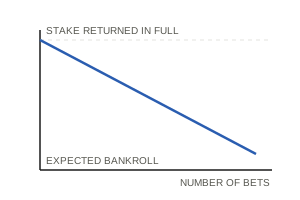
The advantage a gambling game holds is not luck, a streak or a mood. It is a fixed fraction of every stake, written into the payout terms before anyone plays.
Field notes
More
All guides, most recently revised first
Mathematics · Updated 17 August 2026
Why the house edge decides every long game
A fixed fraction of every stake, set by paying less than true odds.
Mathematics · Updated 17 August 2026
Probability, odds and expected value
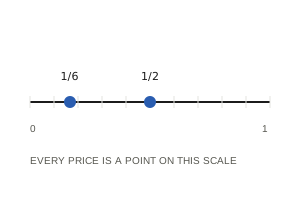
Fractional, decimal and implied probability, and how expectation is computed.
Games · Updated 17 August 2026
Roulette: a fixed edge built into the wheel
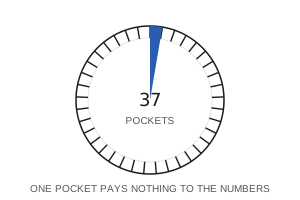
One or two extra pockets set an edge that every bet on the cloth shares.
Games · Updated 17 August 2026
Dice: the oldest randomiser
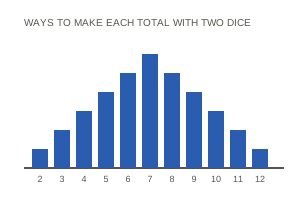
The thirty-six outcomes of two dice, and the pass line derived from them.
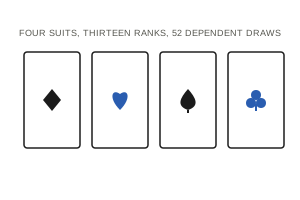
Games · Updated 17 August 2026
Cards: where skill changes the arithmetic
Dependent draws, combinatorics of 52 cards and the limits of skill.
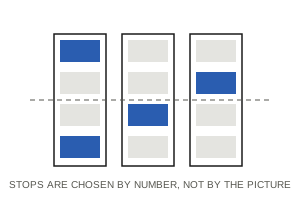
Games · Updated 17 August 2026
Slot machines: from reels to number generators
Weighted stops, virtual reels and what a return figure actually means.
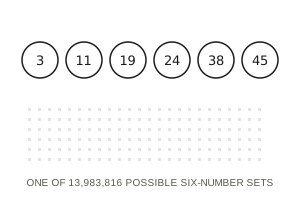
Games · Updated 17 August 2026
Lotteries: the arithmetic of very long odds
Combinations, prize-fund share, rollovers and shared jackpots.
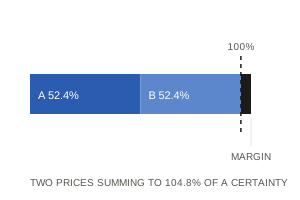
Games · Updated 17 August 2026
Betting markets, prices and the overround
Converting prices to probabilities and reading the margin in a book.
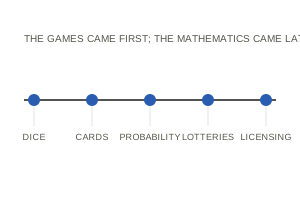
History · Updated 17 August 2026
A short history of games of chance
Astragali to cards to the seventeenth-century correspondence that started probability.
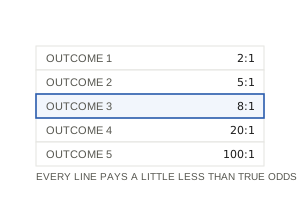
Design · Updated 17 August 2026
How games of chance are designed
Paytables set below true odds, hit frequency and the volatility trade-off.
Regulation · Updated 17 August 2026
How regulation of the industry developed
From prohibition to licensing, testing regimes and published return figures.
Glossary · Updated 17 August 2026
Glossary of terms
Twenty-four defined terms with links into the guide that develops each.
Method · Updated 17 August 2026
How these guides are written
Scope, derivation, and what this site deliberately does not do.
Seven common bets, and what each keeps
Each row is derived from the payout terms alone. The last column shows the arithmetic.
| Bet | Payout terms | Expected return | House edge | Arithmetic |
|---|---|---|---|---|
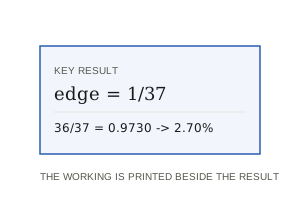
| Single-zero roulette, straight | 35 to 1, 1 of 37 | 0.9730 | 2.70% | 36/37 |
| Double-zero roulette, straight | 35 to 1, 1 of 38 | 0.9474 | 5.26% | 36/38 |
| Coin toss at evens | 1 to 1, 1 of 2 | 1.0000 | 0.00% | 2 x 1/2 |
| Craps pass line | 1 to 1, p = 244/495 | 0.9859 | 1.41% | 2 x 244/495 |
| Lottery, 6 from 49 jackpot | share of prize fund | set by fund share | large | 1 in 13,983,816 |
| Two-way market at 10/11 each | 10 to 11 both sides | 0.9545 | 4.55% | 1/1.0476 |
| Machine stating 96% return | declared paytable | 0.9600 | 4.00% | 1 - 0.96 |
How these guides are worked out
Every figure on this site is derived from the stated rules of the game it describes, using elementary probability, and the arithmetic is printed beside the result so that a reader can check it. No gambling company, product or offer is named, rated or linked anywhere on the site, and nothing here is certified or assessed. These guides explain how the games work and why the arithmetic favours whoever sets the terms; they do not explain how to play, and they treat gambling as a subject rather than an activity to take up.