History · Updated 17 August 2026
A short history of games of chance
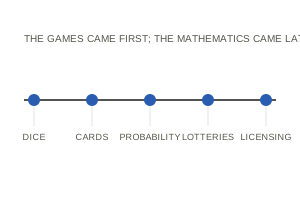
People played games of chance for thousands of years before anyone could calculate them. The mathematics arrived last.
Bones and cubes
The earliest randomisers were not designed. Astragali -- the ankle bones of sheep and goats -- land on four distinguishable faces with unequal frequencies, and were thrown for divination and for play across the ancient Near East and the Mediterranean world. Cubic dice with pipped faces followed, appearing in archaeological contexts across the classical world, and by the Roman period dice play was common enough to attract both moral complaint and legal restriction.
Cards arrive in Europe
Playing cards reached Europe in the later fourteenth century, arriving through Mediterranean trade routes from the Islamic world, and spread rapidly enough that municipal prohibitions on card play appear within a few decades of the first records. Suit systems varied by region -- cups, coins, swords and batons in the south; hearts, bells, leaves and acorns in German-speaking lands -- before the French suits, cheap to print from stencils, became dominant and were carried into English-speaking use.
The mathematics, at last
Games were played for millennia without anyone being able to say how often a result should occur. Gerolamo Cardano, a physician and gambler, wrote a manuscript on games of chance in the sixteenth century that already contained the idea of counting equally likely cases, though it circulated only long after his death. The decisive moment came in 1654, when a correspondence between Blaise Pascal and Pierre de Fermat over how to divide the stakes of an interrupted game produced the systematic treatment of expectation. Christiaan Huygens published the first printed treatise shortly afterwards, and Jacob Bernoulli's work on the law of large numbers, published in 1713, explained why long runs converge and short ones do not.
Lotteries as public finance
While the mathematics developed, lotteries became an instrument of state. Renaissance Italian and Low Country cities drew lots to fund civic works, and the mechanism spread as a way of raising money without direct taxation. Public and colonial lotteries funded infrastructure and colleges in Britain and North America. Recurrent scandal, private imitation and outright fraud eventually discredited the format, and many jurisdictions prohibited lotteries outright during the nineteenth century.
Resorts, machines and the modern industry
Nineteenth-century Europe produced the gambling resort as a destination, built around roulette and card rooms attached to spa towns; the single-zero wheel is itself an artefact of competition between such houses, since removing the double zero was a way of offering a better game. In the same period the mechanical payout machine appeared, industrialising play in a form that needed no dealer and no other players. The twentieth century added legal casino jurisdictions, state lotteries reintroduced as public revenue, licensed betting shops, and finally networked play, each step turning what had been an intermittent social activity into a continuously available supervised industry.
One thread through all of it
The constant across four thousand years is that the person offering the game sets the terms. Whether the device is a knucklebone, a wheel, a printed slip or a number generator, the arithmetic of paying slightly less than true odds has not changed. What changed is the speed of play, the accuracy with which the terms can be calculated, and the degree to which they are supervised.
What this does not tell you
This is a summary of a long and regionally varied history. Dates for the earliest dice and cards are approximate and contested, and the account here is deliberately broad.