Games · Updated 17 August 2026
How Betting Bankroll Limits Work: A Practical Checklist
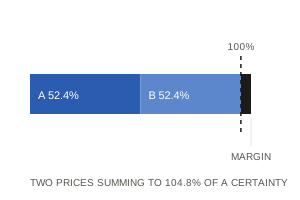
Add up the implied probabilities of every outcome in a market. The amount by which the total exceeds certainty is the margin.
Betting bankroll limits are pre-set caps on how much money you can deposit, wager, or lose within a given period, and they work by enforcing discipline through sportsbook tools and personal rules. A practical checklist includes setting a total bankroll you can afford to lose, choosing a unit size of 1-5% of that bankroll, and using deposit, wager, and loss limits to prevent overspending. These limits are essential for responsible gambling and long-term enjoyment.
What Are Betting Bankroll Limits?
Betting bankroll limits are restrictions you place on your gambling funds to control spending and risk. They can be self-imposed, such as deciding to bet only 2% of your bankroll per wager, or enforced by sportsbook tools like deposit caps and loss limits. According to OddsIndex, every legal US sportsbook is required to offer responsible gambling tools, including deposit limits, wager limits, and self-exclusion. These tools help you manage your bankroll by setting hard stops on how much money enters your account and how much you can stake.
Bankroll limits are not just for problem gamblers; they are standard features for all bettors. Using them proactively can prevent impulsive decisions and keep betting fun. The key is to set limits before you start betting, not after a losing session.
Why Bankroll Limits Matter
Bankroll limits protect you from financial harm and emotional stress. RG.org explains that responsible bankroll management minimizes risks, enhances betting longevity, and improves decision-making. Without limits, it's easy to chase losses or bet more than you can afford, leading to a depleted bankroll and potential financial trouble.
Limits also help you treat gambling as entertainment, not a money-making scheme. The National Council on Problem Gambling advises budgeting gambling as an entertainment expense, like streaming subscriptions or football tickets. Setting limits ensures you stay within that budget.
Types of Bankroll Limits
There are several types of limits you can use to manage your bankroll:
- Deposit limits: Cap the amount you can add to your account daily, weekly, or monthly. OddsIndex notes that decreasing a limit takes effect immediately, while increasing it requires a cooling-off period of 24-72 hours.
- Wager limits: Restrict how much you can bet per wager or per day. This prevents you from blowing your bankroll on a single impulsive bet.
- Loss limits: Set a maximum amount you're willing to lose in a session or day. OddsIndex's bankroll guide suggests a daily loss limit of 5-10% of your bankroll.
- Time limits: Control how long you spend betting. Many sportsbooks offer session reminders or reality checks to help you track time.
- Self-exclusion: A formal program that blocks you from betting for a set period, useful if you need a complete break.
How to Set Your Bankroll and Unit Size
Your bankroll is the total amount of money you set aside exclusively for betting. It should be money you can afford to lose without affecting your daily life. OddsIndex recommends asking yourself: if I lost this entire amount tomorrow, would it change anything? If yes, the amount is too high.
Once you have a bankroll, determine your betting unit. A unit is a fixed percentage of your bankroll, typically 1-5%. For example, with a $1,000 bankroll and a 2% unit, each unit is $20. This system scales with your bankroll and prevents overbetting. RG.org suggests starting at the lower end of the range if you're new or risk-averse.
Practical Checklist for Bankroll Limits
Use this checklist to implement bankroll limits effectively:
- Set a total bankroll: Decide on an amount you can afford to lose, separate from living expenses.
- Choose a unit size: Pick 1-5% of your bankroll as your standard bet size.
- Set deposit limits: Match your deposit limit to your monthly betting budget on all sportsbook accounts.
- Set wager limits: Cap your per-bet amount to avoid impulsive large wagers.
- Set loss limits: Decide on a daily or weekly loss threshold (e.g., 5-10% of bankroll) and stop when reached.
- Set time limits: Use session reminders or set a timer to avoid extended play.
- Track your bets: Keep a log of every bet to monitor performance and adherence to limits.
- Review and adjust: Periodically reassess your limits based on your financial situation and betting goals.
Common Mistakes to Avoid
Many bettors fail because they don't stick to their limits. OddsIndex highlights poor bankroll management as the top reason recreational bettors go broke. Avoid these mistakes:
- Chasing losses: Increasing bet size after losses to recoup money, which often leads to bigger losses.
- Betting with money you can't afford to lose: Using rent, savings, or borrowed funds for betting.
- Ignoring deposit limits: Not setting or exceeding deposit caps, leading to overspending.
- Overconfidence: Betting more than your unit size on a "sure thing."
- Not tracking bets: Without records, you can't see if you're staying within limits.
When to Seek Help
If you find yourself unable to stick to your limits, borrowing money to gamble, or gambling affecting your relationships or work, it may be time to seek help. The National Problem Gambling Helpline offers free, confidential support at 1-800-MY-RESET or via chat at ncpgambling.org/chat. Remember, gambling should be fun, and limits are there to keep it that way.
Recommended Resources:
What this does not tell you
These conversions describe the arithmetic of quoted prices only. No market, operator or product is named or assessed here, and nothing on this page is a suggestion to bet.