Games · Updated 17 August 2026
Payment Collection: A Practical Guide for Enterprise Operations
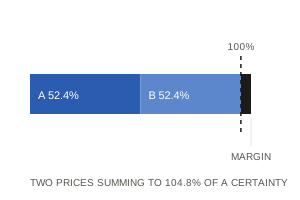
Add up the implied probabilities of every outcome in a market. The amount by which the total exceeds certainty is the margin.
Your invoices go out on time. The cash does not come back on time. Collections stall because reminders sit in one system, payment confirmations land in another, and reconciliation happens in a spreadsheet days later. This breakdown of Whatsapp Business API covers the trade-offs in more depth.
This guide maps the full collection workflow, from invoice issuance to remittance matching, and shows where automation pays off. You will learn how to compare WhatsApp, email, and self-service portals, design dunning sequences that protect relationships, and build audit-ready reporting. It also covers what to verify on security and compliance before scaling, and how a unified platform such as Com.bot fits into enterprise rollouts.
Why Payment Collection Breaks Down at Enterprise Scale

At enterprise scale, a single missed payment reminder can cascade into a 90-day delinquency, turning a routine receivable into a bad debt write-off. The stakes rise with every zero added to the transaction volume. What works for a small business with fifty invoices a month collapses under the weight of fifty thousand.
Enterprise payment collection is not simply about sending invoices. It means managing complex buyer hierarchies, where a single corporate parent may hold dozens of legal entities, each with its own payment terms, approvers, and billing contacts. A purchase order might route through procurement, legal, and finance before anyone touches an invoice.
Add multiple approval layers and the picture gets murkier. A net 60 invoice can sit in an approval queue for weeks without anyone flagging it as overdue. Meanwhile, high transaction volumes mean errors compound quietly. Inefficient collections can contribute to revenue leakage that rarely shows up as a single line item.
That leakage matters because accounts receivable is working capital. Every day an invoice stays unpaid is a day that cash cannot fund operations, payroll, or growth. Delinquency also distorts the aging report, making it harder to spot genuine credit risk versus simple process failure.
Three failure points drive most of this breakdown: fragmented channels, manual reconciliation, and delayed follow-up. Each one is manageable in isolation. Together, they create a collection strategy that leaks cash at every stage of the order-to-cash cycle.
Common Failure Points: Fragmented Channels, Manual Reconciliation, and Delayed Follow-Up
When invoices are sent via email, reminders via phone, and payments via bank transfer, the left hand rarely knows what the right hand is doing. That fragmentation is the first and most visible failure point. A finance team juggling a shared inbox, a customer portal, and a spreadsheet of call notes has no single source of truth.
The result is inconsistent messaging. One customer gets a polite nudge, another gets nothing, and a third receives a duplicate reminder that damages the relationship. Missed follow-ups become normal rather than exceptional. Soft collection efforts quietly fall through the cracks before anyone escalates to a demand letter.
The second failure point is manual reconciliation. Staff spend hours matching payments to invoices, especially when customers pay partial amounts or bundle several invoices into one transfer. Every manual match is a chance for error. Misapplied payments create phantom overdue balances, trigger unnecessary reminders, and inflate the allowance for doubtful accounts.
The third failure point is delayed follow-up. When reminders go out 30 or more days past the due date, the window for a soft collection has already closed. What could have been a friendly payment reminder becomes a hard collection conversation, and bad debt risk climbs accordingly.
Consider a mid-market distributor that faced all three problems at once. Invoices went out by email, reminders by phone, and reconciliation lived in spreadsheets. After consolidating channels, automating payment matching, and moving reminders to a scheduled cadence before the due date, the company improved its days sales outstanding. The collection strategy did not change. The execution did.
That outcome points to a broader lesson. Most enterprises do not need a more aggressive credit policy. They need consistent execution across every stage: invoice generation, invoice delivery, payment reminder timing, and escalation. Fixing the three failure points restores visibility into the aging report and turns collections from a reactive scramble into a predictable process.
Mapping Your Payment Collection Workflow End to End
A typical enterprise order-to-cash cycle involves many discrete steps, from quote approval to cash application, and each handoff is a potential point of failure. Mapping that cycle end to end is the first real step toward automation, because you cannot improve a process you have never documented.
Most teams know the broad shape of their O2C flow. Fewer can say exactly where an invoice stalls, who owns the next action, or how long each stage actually takes. That gap between assumption and reality is where revenue leakage quietly accumulates.
A practical mapping exercise traces a single order through every stage: quote approval, credit check, order entry, fulfillment, invoice generation, invoice delivery, payment terms assignment, reminder scheduling, payment capture, remittance matching, exception handling, and final cash application. At each handoff, note three things:
- The system of record holding the data
- The person or team responsible for the next action
- The average time the step takes, measured rather than estimated
Gaps tend to cluster at transitions between systems. An ERP generates the invoice, a separate tool sends it, a spreadsheet tracks the due date, and a shared inbox holds the remittance. Nothing is broken individually, yet the seams between them create delay, duplicate work, and missed follow-ups.
These seams matter because working capital depends on velocity, not effort. A billing cycle that adds three days of manual review before an invoice leaves the building pushes the due date out and stretches DSO without anyone deciding to offer better payment terms. Mapping exposes those hidden extensions.
Once the workflow is visible, patterns emerge. Certain customer segments, invoice types, or regions consistently lag. Aging reports confirm what the map suggests: delinquency is often structural, not behavioral. That distinction determines whether you need a firmer collection strategy or simply a faster process.
Document the map once, then treat it as a living artifact. Update it as payment terms change, as new billing channels appear, and as credit policy evolves. The map becomes the baseline against which every automation decision is judged.
From Invoice Issuance to Remittance Matching: Where Automation Pays Off
Automating invoice delivery alone can shorten DSO, but the real ROI comes from automating the entire remittance matching process. The workflow breaks into five stages, and each responds differently to automation.
Invoice generation is usually the easiest win. Auto-populating invoice data directly from the ERP removes transcription errors and ensures line items, tax treatment, and payment terms match the underlying order. Errors caught here prevent disputes later, and disputes are one of the most common causes of extended delinquency.
Invoice delivery benefits from multi-channel distribution. A single customer may prefer a portal, another wants email with a PDF attachment, and a third requires EDI or a supplier network. Automation routes each invoice through the correct channel automatically, which removes manual sorting and reduces the chance that an invoice never arrives. Automated delivery can meaningfully reduce manual effort compared with batch-and-send approaches.
Reminder scheduling turns payment terms into a timed sequence. Rather than relying on a collector to notice an approaching due date, the system triggers a payment reminder before the date, a follow-up after it passes, and an escalation when the overdue payment crosses a threshold. This is where a soft collection cadence becomes consistent instead of personality-dependent.
Payment capture covers how cash actually arrives: ACH, wire, card, check, or portal payment. Automation here means reconciling the incoming payment to the open invoice as soon as it lands, rather than waiting for a monthly bank reconciliation.
Remittance matching is the hardest and highest-value stage. Payments frequently arrive without clear remittance detail, forcing a collector to guess which invoices a lump sum covers. AI-based matching reads remittance advice, payment portals, and bank feeds, then proposes the allocation. This can cut reconciliation time substantially and reduce unapplied cash.
| Stage | Manual Approach | Automated Approach | Primary Benefit |
|---|---|---|---|
| Invoice generation | Re-keyed from order data | Auto-populated from ERP | Fewer errors and disputes |
| Invoice delivery | Batch email or print and mail | Multi-channel routing by customer rule | Faster delivery, less manual effort |
| Reminder scheduling | Collector tracks dates manually | Triggered sequence by due date | Consistent follow-up |
| Payment capture | Periodic bank reconciliation | Real-time posting on receipt | Current cash position |
| Remittance matching | Manual allocation from advice | AI-assisted allocation | Less unapplied cash |
The pattern across all five stages is the same: automation removes the waiting time between an event and the response to it. That waiting time is invisible on an aging report but shows up as slower cash flow and higher days sales outstanding.
Prioritize by where the map showed the longest delays. If invoices sit for days before delivery, start there. If cash arrives but sits unapplied, remittance matching delivers more. If reminders depend on one person's memory, scheduling comes first.
Automation does not remove the need for a collection strategy, a credit policy, or judgment on difficult accounts. It removes the mechanical work so that collectors can spend their time on the accounts that genuinely need a conversation, not on chasing data that a system should have handled.
Choosing the Right Collection Channels for Enterprise Customers
Enterprise customers expect to be reached on their preferred channel, and using the wrong one can delay payment by weeks. A finance team that sends a demand letter through a chat app, or a soft nudge through a formal legal channel, signals that it does not understand the relationship it is trying to protect.
Channel choice affects two things at once: response rates and relationship management. The same overdue payment message can strengthen a partnership or strain it, depending entirely on where and how it arrives. This is why collection strategy in enterprise operations is less about templates and more about matching tone and medium to the moment.
Three channels dominate modern accounts receivable work:
- WhatsApp, for fast, conversational contact with the people who actually process invoices
- Email, for formal notices, documentation, and audit-ready trails
- Self-service portals, for payment, invoice retrieval, and dispute resolution
No single channel covers every scenario. The strongest programs use multi-channel orchestration, moving a customer through channels as an invoice ages and the situation shifts from a gentle reminder to a formal escalation. The comparison below breaks down where each channel performs best.
WhatsApp, Email, and Self-Service Portals Compared
WhatsApp messages tend to get high open rates, but email remains the preferred channel for formal demand letters and audit trails. That gap tells you a lot about how to sequence outreach. High visibility does not equal high formality, and formality matters once an overdue payment crosses into escalation territory.
Speed of response is WhatsApp's clearest advantage. Messages are typically read quickly, which makes it effective for soft collection touches: confirming an invoice arrived, checking whether a purchase order is missing, or asking about a due date. Email, by contrast, tends to have lower open rates, but it produces the timestamped record that finance teams need when a dispute escalates.
Cost and scalability run in the opposite direction. WhatsApp and email both scale cheaply across thousands of accounts, while self-service portals carry higher build and maintenance costs. Portal login rates vary widely by customer segment, and many enterprise buyers never log in unless a workflow forces them to.
Formality also shapes suitability. A demand letter belongs in email or a formal letter, never in a chat thread. Portals suit customers who want autonomy over payment terms, invoice copies, and dispute filing without waiting on a human.
A tiered approach works best:
- WhatsApp for soft reminders in the first days after a due date
- Email for formal notices and any communication that may become evidence
- Portals for self-service payment, invoice history, and dispute resolution
The decision matrix below summarizes the tradeoffs.
| Dimension | Self-Service Portal | ||
|---|---|---|---|
| Speed of response | Very fast, often minutes | Slow, hours to days | Depends on customer login |
| Formality | Low, conversational | High, documented | Neutral, transactional |
| Cost to scale | Low | Low | Higher build and upkeep |
| Audit trail | Weak | Strong | Strong for transactions |
| Best fit | Soft reminders | Formal notices, escalation | Payments, disputes |
Read the matrix as a sequence, not a menu. Start soft on WhatsApp, document on email as delinquency deepens, and let the portal handle the mechanics of payment and dispute. That progression keeps cash flow moving while preserving the relationship and the paper trail.
Automating Payment Reminders and Dunning Sequences
A well-designed dunning sequence can recover a large share of overdue payments without human intervention, but only if escalation logic is calibrated to customer value. Treating every overdue invoice the same way is one of the most common mistakes in accounts receivable management.
Dunning is not a single template blasted to every delinquent account. It is a segmented communication strategy that changes tone, channel, and urgency based on who owes the money and how much is at stake. A late payment from a strategic enterprise client with a long-standing relationship requires a very different approach than a chronically overdue balance from a high-risk account.
Segmentation usually starts with two dimensions: customer value and credit risk. High-value, low-risk customers may simply need a gentle nudge, while low-value, high-risk accounts warrant faster escalation. A customer with a strong payment history and a temporary cash flow issue should not receive the same collection letter as one with repeated delinquency.
Escalation logic also has to balance firmness with relationship preservation. Push too hard and you risk losing a customer. Push too softly and your working capital suffers. The goal is a sequence that gets progressively more direct while still leaving room for dialogue and resolution.
Automation makes this practical at scale. Triggered reminders, scheduled follow-ups, and channel switching keep the process consistent even when account managers are stretched thin. The next section breaks down how to design that escalation ladder stage by stage.
Designing Escalation Logic That Preserves Customer Relationships
The difference between a recovered payment and a lost customer often comes down to the tone and timing of the second reminder. A structured escalation ladder gives your team a repeatable framework while still allowing room for judgment on high-value accounts.
Here is a practical five-stage sequence that balances persistence with relationship care:
- Day 1: Friendly reminder via WhatsApp or your preferred messaging channel. Assume the due date simply slipped their mind.
- Day 7: Email with the invoice attached and a clear payment link. Slightly more formal, still courteous.
- Day 14: Phone call from the account manager. A live conversation surfaces issues that automated messages cannot.
- Day 30: Formal demand letter. This signals that the matter is now serious and documented.
- Day 45: Referral to a third-party collection agency or hard collection process.
Personalization is what keeps this from feeling robotic. High-value customers should get more lenient timelines, sometimes stretching each stage by a week or more. A customer with a strong payment history who hits a rough quarter deserves patience. A repeat offender with a maxed-out credit limit does not.
Scripts help maintain consistency without sounding scripted. A Day 1 message might read: "Hi [Name], just a quick note that invoice #[number] was due on [date]. Let us know if you need anything to process it." By Day 14, the tone shifts: "I wanted to check in personally about the outstanding balance. Is there anything on your end holding up payment?"
Maintaining rapport matters as much as recovering cash. Offering a payment plan or installment option at the Day 14 or Day 30 stage often converts a stalled account into a paying one. Documenting every touchpoint in the aging report keeps the collection strategy transparent and defensible if the relationship or account escalates further.
Reconciliation, Reporting, and Audit Readiness
Without a single source of truth, finance teams spend significant time reconciling disparate reports instead of analyzing cash flow trends. That gap between what the ledger shows and what the bank confirms is where errors, disputes, and audit findings tend to hide.
Real-time reconciliation closes that gap. When every payment posted against an invoice is matched automatically, the accounts receivable ledger reflects actual cash positions rather than estimates. Reporting then becomes a decision tool instead of a monthly archaeology project.
Audit readiness follows the same discipline. Auditors and controllers need an unbroken trail from invoice generation through payment terms, reminders, and final settlement. If a customer disputes a charge or a payment is applied to the wrong account, that trail shows exactly where the break occurred.
Three habits strengthen this trail:
- Match payments to invoices daily, not at month end
- Log every payment reminder, collection letter, and escalation with a timestamp
- Reconcile gateway settlements against bank deposits on a fixed schedule
Delinquency and bad debt provisions also depend on accurate aging data. A misstated aging report distorts the allowance for doubtful accounts, which in turn misleads leadership about working capital. Clean reconciliation protects the numbers that drive credit policy and collection strategy decisions.
Building a Single Source of Truth for Finance and Operations Teams
A single source of truth means that when a customer pays, the invoice status updates instantly across ERP, CRM, and collections dashboards. No one has to ask which system holds the correct figure, because there is only one answer.
Getting there requires integration across the systems that touch the order-to-cash cycle. The ERP holds the ledger. Payment gateways hold settlement data. Communication platforms hold the reminder and dunning history. A centralized dashboard pulls these streams together so finance and operations see the same picture.
Key capabilities to look for include:
- Real-time aging reports that refresh as payments land, not overnight
- Automated reconciliation that flags mismatches between gateway totals and bank deposits
- Audit logs capturing who changed what, when, and why
- Drill-down from a summary metric to the underlying invoice and payment record
With that foundation, teams can track a focused set of metrics. Days sales outstanding (DSO) shows how quickly cash converts. The collection effectiveness index (CEI) measures how much of collectible receivables actually gets collected. Percentage current and percentage over 90 days reveal whether delinquency is worsening or improving.
The payoff is practical. Automated matching removes manual spreadsheet work, so analysts spend time on cash flow trends instead of chasing discrepancies. Audit readiness improves because the trail from invoice to payment is continuous and verifiable. And when revenue leakage or a missed due date pattern appears, the dashboard surfaces it early enough to act rather than explain.
Security, Compliance, and Data Protection in Payment Collection
A data breach during payment collection can be costly for an enterprise, not to mention reputational damage. That risk alone explains why security cannot be treated as a back-office concern that sits apart from billing and accounts receivable operations.
Payment collection touches some of the most sensitive financial data an enterprise holds. Bank account numbers, card details, tax identifiers, and full invoice histories all pass through the collection workflow, and each one carries regulatory weight.
Three frameworks shape most enterprise obligations. GDPR governs personal data for customers in the EU and UK, including how long payment records may be retained. PCI DSS sets the baseline for handling card data, even when a third party processes the transaction. SOC 2 reports give assurance that controls around confidentiality and availability have been independently examined.
Compliance is not only a technology problem. It is also a process and vendor management problem. A platform can be certified while a collections team still emails spreadsheets of overdue accounts, or shares login credentials across staff. Controls that exist on paper but not in daily practice offer little protection.
Vendor management matters just as much. Every processor, messaging provider, and payment gateway in the collection chain expands the attack surface. Enterprises should know which vendors touch payment data, what contractual protections apply, and how each one handles a suspected incident.
Security also supports the financial goals of enterprise operations. When customers trust that their payment details and invoice data are handled carefully, disputes decline and collection cycles run more predictably. Strong controls protect cash flow as much as they protect reputation.
What Enterprises Must Verify Before Scaling Collections
Before scaling collections, enterprises must verify that their platform provider meets a thorough set of security and compliance criteria, from encryption standards to data residency. Scaling multiplies volume, and any weak control multiplies with it.
The checklist below covers the core items to confirm before expanding collection activity across regions, entities, or customer segments.
- End-to-end encryption for data in transit and at rest, with current TLS standards and managed key rotation.
- Role-based access control so collectors, analysts, and administrators see only the accounts and fields their role requires.
- Audit logs that record who accessed or changed an invoice, payment record, or customer credit file, and when.
- Compliance certifications such as ISO 27001 and SOC 2, with reports available under NDA rather than a logo on a web page.
- Data residency options for storing records in the jurisdictions where customers and regulators expect them.
- Incident response plans with defined notification timelines, escalation contacts, and post-incident review commitments.
Assessment goes beyond the checklist. Request recent penetration test results and confirm that findings were remediated, not just documented. Review service level agreements for uptime, breach notification windows, and support response times.
Send a security questionnaire covering data flows, subcontractors, staff screening, and disaster recovery. Red flags include vague answers about subprocessors, refusal to share audit reports, no documented incident history, and contracts that shift all liability to the customer.
Revisit verification annually and after any major change in scope. A provider that passed review at a hundred invoices a month may need fresh scrutiny at ten thousand.
Running Payment Collection on a Unified Communication Platform
A unified communication platform consolidates all collection channels into one interface, eliminating data silos and enabling seamless automation. Instead of juggling email threads, phone logs, and payment portals, finance and support teams work from a single view of every customer conversation.
For enterprises with global operations, this matters even more. Time zones, currencies, and channel preferences vary by region, and a fragmented stack makes consistent payment collection nearly impossible. A unified approach keeps invoice delivery, reminders, and payment confirmations tied to the same customer record.
The practical result is a shorter order-to-cash cycle. When a reminder goes out and a payment lands, both events update the same system, so aging reports stay accurate without manual reconciliation. Automation then handles the repetitive steps that slow down accounts receivable teams.
A unified platform typically combines three capabilities:
- Messaging that reaches customers where they already are, such as WhatsApp, Facebook, or Instagram
- Payments that let customers settle an invoice without leaving the conversation
- Workflow automation that triggers reminders, escalations, and status updates based on due dates and payment behavior
This structure supports both soft collection, where friendly reminders resolve most overdue balances, and escalation paths when accounts pass key aging thresholds. The sections below show how Com.bot applies this model to enterprise collections.
How Com.bot Supports Collections via WhatsApp Business API and Native Payments
Com.bot integrates the WhatsApp Business API with native payment capabilities, allowing enterprises to send invoices, reminders, and collect payments without leaving the chat. As an Official Meta Business Partner, Com.bot connects directly to the WhatsApp Business API, which means collections run on the channel customers already check daily.
The Unified Team Inbox gives collection teams one place to manage every customer conversation across WhatsApp, Facebook, and Instagram. Agents see the full history, so a payment reminder never arrives after a customer has already paid. Role-based access keeps sensitive account data visible only to the right people.
The Visual Bot Builder uses a drag-and-drop interface to automate dunning sequences. An enterprise can configure a flow that sends a friendly reminder before the due date, a follow-up on the due date, and a firmer notice once an invoice becomes overdue. Each step can branch based on whether payment has been received.
A typical enterprise setup might look like this:
- Upload or sync outstanding invoices into the platform
- Build a dunning sequence in the Visual Bot Builder tied to payment terms such as net 30 or net 60
- Send the invoice with a one-click payment link through WhatsApp
- Trigger real-time payment status updates back to the customer and the internal team
- Escalate unresolved accounts to a human agent through the Unified Team Inbox
Native Payments for WhatsApp removes the friction of switching to a separate portal. Customers pay inside the chat, and the status updates automatically, which reduces delinquency and supports healthier working capital.
Pricing, Add-Ons, and Global Coverage for Enterprise Rollouts
Com.bot offers three pricing tiers: Silver at $149 per quarter, Gold at $349 per quarter (recommended), and Platinum V1 at $2500 per quarter. For most enterprises running payment collection at scale, the Gold plan strikes the best balance between capability and cost.
Add-ons cost $10 per month each for an additional team member, social channel, or block of 5000 external actions. The same rate applies to bot triggers per 25000 and an ecom store. WhatsApp messaging is billed at actual Meta rates with no markup, which keeps per-message collection costs predictable as volume grows.
Com.bot is available worldwide and serves 50+ countries, making it viable for enterprises with cross-border accounts receivable. Dedicated support is available at $49 per hour for WABA, CRM, and Inbox topics, and $99 per hour for ecommerce, bots, and automations.
Here is a cost-benefit view for a typical enterprise with 10 team members and 20,000 monthly external actions:
| Item | Detail |
|---|---|
| Base plan | Gold at $349 per quarter |
| External actions | 20,000 monthly actions equal four add-on blocks at $10 per month each |
| Team members | Additional members beyond the plan allowance at $10 per month each |
| WhatsApp messaging | Billed at actual Meta rates, no markup |
Because add-ons are modular, an enterprise can start on Silver, upgrade to Gold as volumes rise, and add social channels or team seats only when needed. That scalability keeps collection costs aligned with actual accounts receivable activity rather than fixed overhead.
Conclusion: Getting Started with Automated Payment Collection
Automating payment collection is no longer a luxury but a necessity for enterprises aiming to optimize working capital and reduce bad debt. The path forward is not a single tool or tactic. It is a sequence of deliberate decisions that build on one another.
This guide covered that sequence from end to end. Each step strengthens the next, and skipping one usually shows up later as revenue leakage or rising delinquency.
Here is the roadmap in brief:
- Map your workflow. Document every stage of the order-to-cash cycle, from invoice generation and delivery through due date, overdue payment, and final resolution. You cannot automate a process you have not defined.
- Choose the right channels. Match payment methods and reminder channels to how your customers actually transact and communicate.
- Automate dunning. Replace manual follow-up with scheduled payment reminders and escalation logic that moves from soft collection to hard collection at defined thresholds.
- Ensure security. Protect payment data, enforce access controls, and keep an audit trail that satisfies both finance and compliance teams.
- Consolidate on a unified platform. Fragmented tools create blind spots. A single system keeps aging reports, collection strategy, and customer history in one place.
These five steps also reinforce one another. A clear workflow makes channel selection easier. Reliable channels make automated dunning more effective. Strong security and a unified platform make the whole system trustworthy enough to scale.
If you are ready to move from manual follow-up to a structured, automated approach, Com.bot can help. Reach out to discuss your requirements, ask questions, or see how the platform fits your enterprise operations.
Contact Com.bot
| Detail | Information |
|---|---|
| Head Office | 501, Trinity Orion, Vesu Main Road, Surat - 395010, IN |
| Phone / WhatsApp | +91 080 6987 1810 |
| [email protected] | |
| Business Hours | Monday - Friday: 9:00 AM - 6:00 PM IST |
| Social | WhatsApp Support available |
Whether you are evaluating your first automation tool or replacing a patchwork of spreadsheets and reminders, a short conversation is often the fastest way to find out what fits. Visit the Com.bot website or contact the team directly to start your automation journey.
Recommended Resources:
What this does not tell you
These conversions describe the arithmetic of quoted prices only. No market, operator or product is named or assessed here, and nothing on this page is a suggestion to bet.